Joshua Borsman · 2026 · Sound installation
Sounding
The Work
Sounding is a continuous, real-time sonification of ocean conditions along the Pacific Northwest coast.
Live measurements from six gauging stations between Charleston, Oregon and Neah Bay, Washington are translated into a layered field of drones, slow harmonic motion, and resonant plucks. The piece is designed to play without repetition for hours at a time. Nothing is sequenced in advance. What you hear at any given moment is shaped by what the ocean is doing at that moment, six minutes ago, at the gauge house nearest the listener.
The work was conceived for the gallery: low-frequency information carried by large speakers, a long reverberant tail, and a slow cadence of attacks that rewards extended attention. It is also intended to function at home, on headphones, as a stable accompaniment to other work.
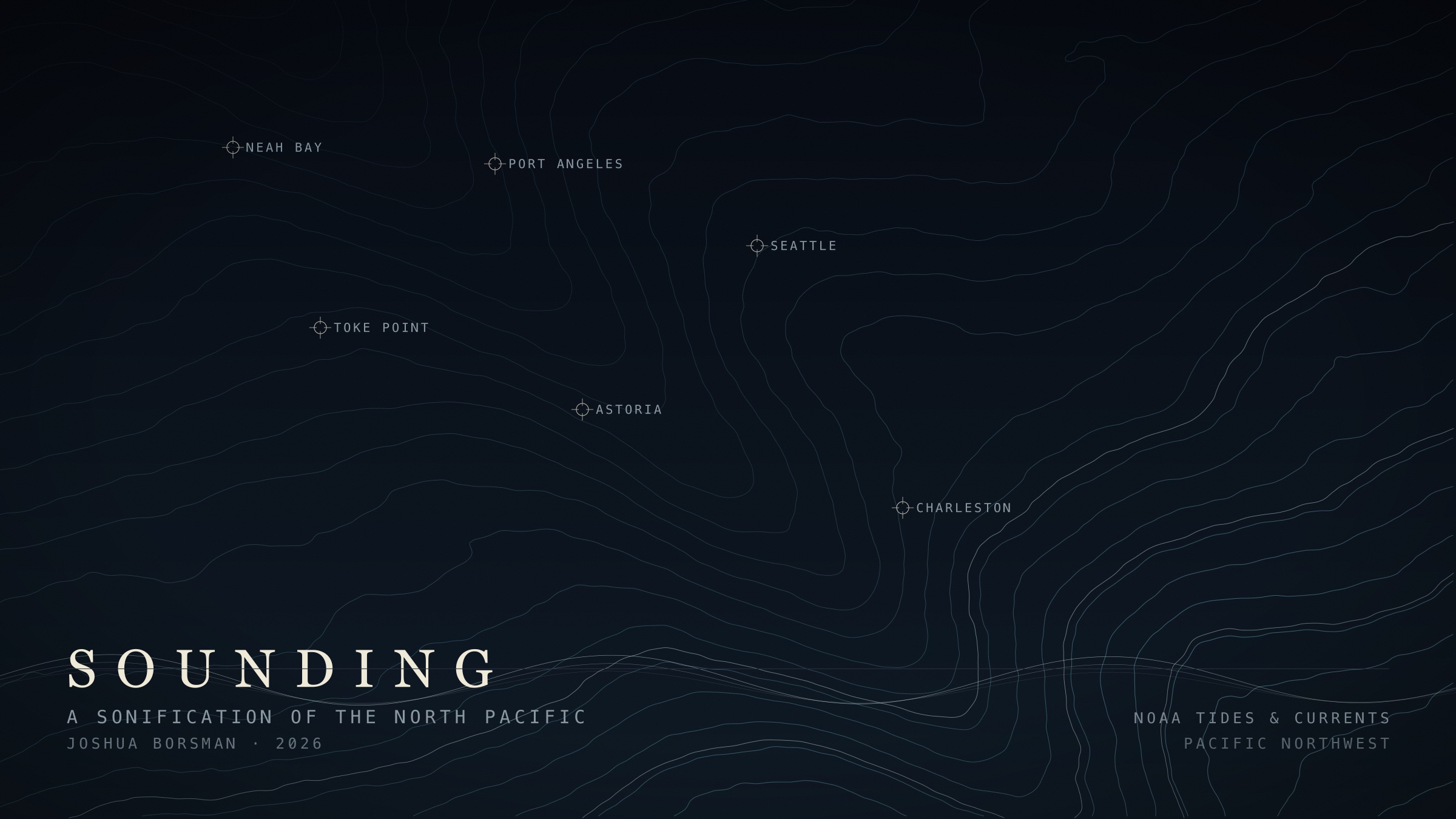
The visual surface follows the same data. A bathymetric field drifts across the canvas, refracting around the silhouettes of two islands and a row of sea stacks; conifer treelines mark the far shore; fog drifts in proportion to mood, denser in stormy weather. The palette of the canvas shifts through dawn, day, dusk, and night on Pacific time — kept low-lit throughout so the room stays contemplative.
The Data
Observations come from two public services run by the National Oceanic and Atmospheric Administration: the CO-OPS Tides & Currents API and the National Weather Service API. Each station contributes water level, water temperature, wind speed and direction, and barometric pressure. Wave height arrives separately from the nearest National Data Buoy Center buoy when one is available.
- Neah Bay, WA9443090
- Port Angeles, WA9444090
- Seattle, WA9447130
- Toke Point, WA9440910
- Astoria, OR9439040
- Charleston, OR9432780
Polls occur at six-minute intervals, matching the cadence at which CO-OPS publishes new water-level data. Between polls, the live state is smoothly interpolated so the sonic field never freezes; the semi-diurnal tidal phase continues to advance on its own clock. When a service is unreachable the piece does not fall silent: it carries forward from the last known state and decays slowly back toward climatological norms.
The Mapping
Each observation is bound to a specific musical parameter. The mapping is fixed and deterministic: a given weather pattern always produces the same sonic shape. Repeated listening teaches the ear to read the ocean by ear alone.
- Tide level & phasechord, register
- Wave heightpluck density, reverb wet
- Wind speedfilter brightness
- Air pressureoverall amplitude
- Water temperaturedrone tuning
The pitch material is fixed to a Lydian mode whose root sits at D2, seventy-three hertz. Drone voices are arranged at the root, fifth, octave, and twelfth. Plucks are quantized to the same scale; their register rises and falls with the tide. Pad chords walk through the bright degrees of the mode — I, II, IV♯, V — as the tide phase advances, with a single moment of vi for shadow.
A composite mood — glassy, calm, restless, building, or stormy — is derived from wind speed, wave height, and barometric pressure. The mood serves as a readable summary on the dashboard and biases the visual field: contour brightness, fog density, and the indicator colors all follow it.
The Apparatus
Sounding runs on two audio paths from the same mapping. The first is a web engine that synthesizes sound entirely in the browser. Its voices are four detuned drones, a pluck with a long decay, two slow harmonic voices, four high shimmer tones that pulse on small movements in the data, and a distant filtered-noise wash. Everything is summed into a procedural convolution reverb with a twenty-two-second tail. The second is a control-voltage path that drives an analog modular synthesizer assembled for the installation. Eight channels carry pitch, a pluck gate, four slow control voltages tied to the live ocean state, a divided tidal clock, and an occasional random gate.
Pacific Northwest wildlife voices appear sparsely through the session and route deeper into the reverb than the plucks, so they arrive as distant calls heard across water. Three of the voices are public-domain federal field recordings: a humpback whale from the NOAA Passive Acoustics Group, an orca from a National Park Service hydrophone in Glacier Bay, and a harbor seal also from the NOAA group. The four bird voices are synthesized: a common loon's wail and a herring gull's long call are heard most often, with bald eagles and great blue herons as rarer punctuation. Whales and orcas favor calm seas; birds are slightly more frequent in light wind; seals occur independently of weather.
The web path is the default. The modular path is reserved for the gallery installation.
The Artist
Joshua Borsman is an artist working in sound, kinetic sculpture, and generative systems. Recent work includes Lightcurve (2024–), a real-time sonification of variable-star photometry, and a live installation marking the bloom of a corpse flower at the Amazon Spheres (2025). His practice spans gallery, public, and digital environments.
Colophon
Set in EB Garamond and JetBrains Mono. Synthesis via the Web Audio API. Control voltages routed to an external modular synthesizer. Data drawn from the NOAA CO-OPS Tides & Currents service, the National Weather Service, and the National Data Buoy Center. Wildlife field recordings from the NOAA Passive Acoustics Group and the National Park Service.
The code, audio synthesis, visual artwork, and accompanying text are © 2026 Joshua Borsman, all rights reserved. The NOAA data, NPS recordings, and NOAA Passive Acoustics Group recordings referenced by the work are in the public domain as works of the U.S. federal government.